Sewer technology passes sniff test
monitoring technology to identify potential odour and corrosion hotspots in urban sewerage networks has been adopted by ASX-listed environmental management technology firm Envirosuite.
The SeweX technology uses mathematical modelling to predict odour and corrosion hotspots and to optimise mitigation strategies in sewer mains, and was developed by researchers from UQ’s Advanced Water Management Centre.
UQ’s technology transfer company UniQuest negotiated a licence agreement with Envirosuite.
AWMC Director Professor Zhiguo Yuan said the technology was developed in response to needs identified by the water industry.
“Corrosion and odour problems in sewers are most often caused by sulphate-reducing bacteria in sewer biofilms that produce hydrogen sulphide,” Professor Yuan said.
“Hydrogen sulphide is released into the atmosphere above the wastewater, causing odour problems, and is converted by sulphide-oxidising bacteria into sulphuric acid, which is corrosive to concrete sewer pipes.
“Sewer networks can include many kilometres of sewer pipe and various topographical elements, such as rising mains, gravity mains, pumping stations and manholes. It is practically difficult to physically inspect all these structures to identify corrosion issues, making modelling a more efficient and cost-effective alternative.”
Envirosuite Chief Scientist Robin Ormerod said corrosion in sewer and drinking water systems was estimated to cost almost $1 billion every year in Australia.
“This technology will keep towns and cities with reduced odour, and will save wastewater operators millions of dollars every year in operational costs and consumer complaint management,” Mr Ormerod said.
“This partnership is an exciting one. Bringing together tools like the UQ-developed SeweX, with Envirosuite’s digital technology focus, is hugely powerful.”
 UniQuest CEO Dr Dean Moss said SeweX incorporated complex algorithms into its model to cleverly predict odour and corrosion hotspots across sewerage networks.
“It is fantastic to see UQ research helping an Australian company like Envirosuite to drive key improvements to the way water utilities manage wastewater to benefit communities right across the country, and even globally,” Dr Moss said.
Envirosuite will integrate SeweX into its product suite in early 2020.
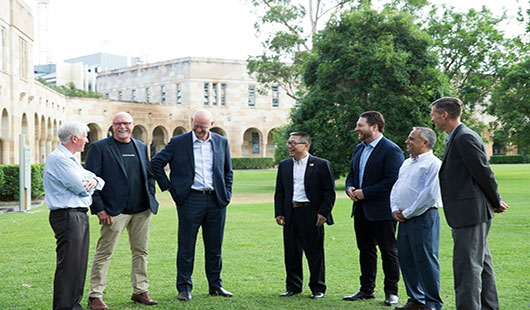
Image: UniQuest project manager Howard Leemon, Envirosuite Chief Scientist and Founder Robin Ormerod, Envirosuite CEO Peter White, UQ’s Advanced Water Management Centre (AWMC) Director and lead researcher, Professor Zhiguo Yuan AM, UniQuest Senior Director and Head of Physical Sciences Alister I. W. Morrison, UQ’s AWMC senior research fellow Dr Keshab Sharma and UniQuest Director, Commercialisation – Physical Sciences, Derek Stephens.
/Public Release. View in full here.best odour control

